After visiting the Bronx Zoo, The Grandma hasbeen reading about the workplace safety and health in the United States, and interesting report published by the U.S.Department of Labor. Remember: Always Be Careful!
Three U.S. Department of Labor (DOL) agencies have responsibility for the administration and enforcement of the laws enacted to protect the safety and health of workers in America.
Occupational Safety and Health Administration
-OSHA administers the Occupational Safety and Health (OSH) Act.
-Safety and health conditions in most private industries are regulated by OSHA or OSHA-approved state plans.
-Nearly every employee in the nation comes under OSHA's jurisdiction with some exceptions such as miners, some transportation workers, many public employees, and the self-employed.
-Employers subject to the OSH Act also have a general duty to provide work and a workplace free from recognized, serious hazards.
-OSHA also administers the Whistleblower Protection program, ensuring an employer cannot retaliate by taking "adverse action" against workers who report injuries, safety concerns, or other protected activity.
-MSHA has responsibility for administration and enforcement of the Mine Safety and Health Act of 1977, which protects the safety and health of workers employed in the nation's mines.
-The Act applies to all mining and mineral processing operations in the United States, regardless of size, number of employees, or method of extraction.
Fair Labor Standards Act
FLSA contains rules concerning the employment of young workers, those under the age of 18, and is administered and enforced by DOL's Wage and Hour Division. Intended to protect the health and well-being of youth in America, the FLSA contains minimum age restrictions for employment, restrictions on the times of day youth may work, and the jobs they may perform.
Other resources
-Office of Workers' Compensation Programs-Administers four major disability compensation programs which provide wage replacement benefits, medical treatment, vocational rehabilitation and other benefits to certain workers or their dependents who experience work-related injury or occupational disease. You can also read more at our workers' compensation topic page.
-Office of the Ombudsman for the Energy Employees Occupational Illness Compensation Program (EEOMBD) and the SHARE initiative also play a role in the administration of DOL workplace safety and health programs.
For help in determining which safety and health standards apply to particular employment situations, select from the subtopics lists. Also, see the Occupational Safety and Health Administration’s webpages on safety and health in the workplace.
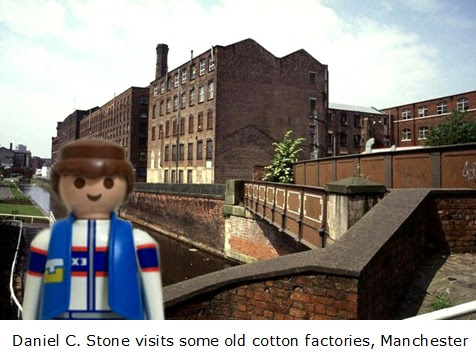
Today, The Stones have received the wonderful visit of one of their closestfriends, DR.
DR is an expert in OccupationalSafety and Health and has accompanied the family while they have been visiting some of the current examples of the industrial golden past of the city of Manchester.
Manchester was very important during the Industrial Revolution thanks to its cotton production. Working two centuries ago was much more dangerous than now but this does not mean that we must notprotect ourselves and take care of us when we are working.
Manchester was a pioneer city in occupational safety and health especially after the Factory Acts of the early nineteenth century (from 1802 onwards) arose out of concerns about the poor health of children working in cotton mills: the Actof 1833 created a dedicated professional Factory Inspectorate.
The Stones have discovered these and other events and they have learnt lots of things about the importance of occupational safety and health.
While they were visiting these factories, The Grandma was doing business. She is preparing a great surprise for the family.
Occupational Safety and Health (OSH), also commonly referred to as Health and Safety, Occupational Health and Safety (OHS), Occupational Health, or Occupational Safety, is a multidisciplinary field concerned with the safety, health, and welfare of people at work.
The goal of an occupational safety and health program is to foster a safe and healthy work environment.
OSH may also protect co-workers, family members, employers, customers, and many others who might be affected by the workplace environment.
In common-law jurisdictions, employers have a common law duty to take reasonable care of the safety of their employees. Statute law may, in addition, impose other general duties, introduce specific duties, and create government bodies with powers to regulate workplace safety issues: details of this vary from jurisdiction to jurisdiction.
The research and regulation of Occupational Safety and Health are a relatively recent phenomenon. As labor movements arose in response to worker concerns in the wake of the Industrial Revolution, worker's health entered consideration as a labor-related issue.
In the United Kingdom, the Factory Acts of the early nineteenth century (from 1802 onwards) arose out of concerns about the poor health of children working in cotton mills: the Act of 1833 created a dedicated professional Factory Inspectorate.
The initial remit of the Inspectorate was to police restrictions on the working hours in the textile industry of children and young persons, introduced to prevent chronic overwork, identified as leading directly to ill-health and deformation, and indirectly to a high accident rate.
However, on the urging of the FactoryInspectorate, a further Act in 1844 giving similar restrictions on working hours for women in the textile industry introduced a requirement for machinery guarding but only in the textile industry, and only in areas that might be accessed by women or children.
In 1840 a Royal Commission published its findings on the state of conditions for the workers of the mining industry that documented the appallingly dangerous environment that they had to work in and the high frequency of accidents. The commission sparked public outrage which resulted in the Mines Act of 1842. The act set up an inspectorate for mines and collieries which resulted in many prosecutions and safety improvements, and by 1850, inspectors were able to enter and inspect premises at their discretion.
Otto von Bismarck inaugurated the first social insurance legislation in 1883 and the first worker's compensation law in 1884, the first of their kind in the Western world. Similar acts followed in other countries, partly in response to labor unrest.
A hazard is an agent which has the potential to cause harm to a vulnerable target.
Hazards can be both natural or human induced. Sometimes natural hazards such as floods and drought can be caused by human activity. Floods can be caused by bad drainage facilities and droughts can be caused by over-irrigation or groundwater pollution.
The terms hazard and risk are often used interchangeably however, in terms of risk assessment, they are two very distinct terms. A hazard is any agent that can cause harm or damage to humans, property, or the environment.
Risk is defined as the probability that exposure to a hazard will lead to a negative consequence, or more simply, a hazard poses no risk if there is no exposure to that hazard.
Hazards can be dormant or potential, with only a theoretical probability of harm. An event that is caused by interaction with a hazard is called an incident. The likely severity of the undesirable consequences of an incident associated with a hazard, combined with the probability of this occurring, constitute the associated risk. If there is no possibility of a hazard contributing towards an incident, there is no risk.
Hazards can be classified in several ways. One of these ways is by specifying the origin of the hazard.
One key concept in identifying a hazard is the presence of stored energy that, when released, can cause damage. Stored energy can occur in many forms: chemical, mechanical, thermal, radioactive or electrical.
Another class of hazard does not involve release of stored energy, rather it involves the presence of hazardous situations. Examples include confined or limited egress spaces, oxygen-depleted atmospheres, awkward positions, repetitive motions, low-hanging or protruding objects.
Hazards may also be classified as natural, anthropogenic, or technological. They may also be classified as health or safety hazards, by the populations that may be affected, and the severity of the associated risk. In most cases a hazard may affect a range of targets, and have little or no effect on others.
Identification of hazards assumes that the potential targets are defined, and is the first step in performing a risk assessment.
Hazards may be grouped according to their characteristics. These factors are related to geophysical events which are not process specific:
-Areal extent of damage zone
-Intensity of impact at a point
-Duration of impact at a point
-Rate of onset of the event
-Predictability of the event
The terms hazard and risk are often used interchangeably. However, in terms of risk assessment, these are two very distinct terms. A hazard is an agent that can cause harm or damage to humans, property, or the environment. Risk is the probability that exposure to a hazard will lead to a negative consequence, or more simply, a hazard poses no risk if there is no exposure to that hazard.
Risk can be defined as the likelihood or probability of a given hazard of a given level causing a particular level of loss of damage.
The elements of risk are populations, communities, the built environment, the natural environment, economic activities and services which are under threat of disaster in a given area.
The total risk according to UNDRO 1982 is the sum of predictable deaths, injuries, destruction, damage, disruption, and costs of repair and mitigation caused by a disaster of a particular level in a given area or areas.
Another definition of risk is the probable frequency and probable magnitude of future losses. This definition also focuses on the probability of future loss whereby degree of vulnerability to hazard represents the level of risk on a particular population or environment. The threats posed by a hazard are:
-Hazards to people – death, injury, disease and stress
-Hazards to goods – property damage and economic loss
-Hazards to environment – loss of flora and fauna, pollution and loss of amenity
After listening to DR's explanations, The Stones have prepared their next visit. Tonight, they are going to travel to Wolverhampton to watch the match between the local team, Wolverhampton Wanderers Football Club and Manchester City in the Molineux Stadium in Wolverhampton, Staffordshire. They have been invited by Pep Guardiola and they are very happy, especially Yolanda Stone.
The Stones, who are still in Hogwarts, have received the wonderful visit of DR, their Occupational Safety andHealth'steacher today.
DR has been talking about labour risks in Hogwarts.This School of Witchcraft and Wizardry is too big to be managed by only one headmaster and it is a responsibility of each member of the school to know and to accomplish the rules about Occupational Safety and Health, especially those related with magic wands.
To know more things about magic wands, The Stones have received the visit of Garrick Ollivander, the most experienced wizard in wands.
Garrick Ollivander (b. 25 September, pre 1908) is a British half-blood wizard who was the proprietor of Ollivanders in Diagon Alley during most of the 20th century.
Ollivander was widely considered the best wandmaker in the world, and many wizards and witches bought their wands from him.
Ollivander was captured and tortured by Lord Voldemort. He was rescued by Harry Potter, Ron Weasley, Hermione Granger, and Dobby. He imparted important information regarding wandlore to Harry, it helped him in his understanding of the Deathly Hallows.
Ollivander's family have
long been associated with the profession of wandcraft. The surname
means he who owns the olive wand which is of Mediterranean origin,
suggesting that the family emigrated to Britain from elsewhere. Mr
Ollivander believes that his ancestors arrived in Britain with the
Romans and set up a stall and eventually a shop, to sell newer and
improved wands to British wizards who had poorly constructed wands that
were unrealiable.
Garrick Ollivander was born to Gervaise Ollivander, a wizard, and his wife, a Muggle-born witch, on the 25 September, in or before the year 1907.
He attended Hogwarts School of Witchcraft and Wizardry in his youth, where he was Sorted into Ravenclaw House.
Ollivander grew up in the family business, and showed precocious talent in wandmaking. Soon, he developed an ambition to improve upon the cores and wand woods he made and developed a determination to pursue the ideal wand.
Before Garrick
Ollivander's proprietorship of Ollivanders, wizards used a wide variety
of wand cores; the customer would often present their wandmaker with a
magical substance to which they were attached, and he would turn it into
their wand core.
Ollivanders Wand Shop, Diagon Alley
Mr Ollivander believed that doing so altered the wand's temperament, and he revolutionised the way wands were crafted by having cores of immensely powerful magical substances expertly enclosed in specially selected and complementary wandwoods, with the result being that the wand would be matched to an owner that the wand itself felt an affinity for.
While there was initially substantial resistance to this new way wands were made, it soon became clear that wands made by Ollivander were far superior to any others. His methods of locating wand woods and core substances, marrying them together, and matching them to ideal owners were all jealously guarded secrets that were coveted by rival wandmakers.
Sometime into his career, in the summer of 1938, Ollivander sold Tom Riddle his wand.
Shortly before the 1984–1985 school year, Ollivander sold a wand to a soon-to-be student of Hogwarts School of Witchcraft and Wizardry, just like he did their brother before them.
As with other wandmakers, Ollivander made it his business to study the mystifying Elder Wand in depth, such as its history and distinctive characteristics. Unlike Hermione Granger, he believed that the Elder Wand was not a myth or tale, and showed great enthusiasm with the powerful object despite the fact that it was dangerous and has had a bloody history. When held captive by Lord Voldemort, he was forced to relate all information he had known about the powerful wand. He also revealed that the last person rumoured to own the wand was Gregorovitch, a foreign wandmaker, though he did not believe the rumour and thought that Gregorovitch spread it to boost his business.
Ollivander supplied Harry Potter with a wand, and as he did so, he told Harry a few facts about wands. He explained that a wand has a core, in Harry's case a phoenix feather. He told Harry that the body of the wand is made from a choice of different woods with different magical properties. Ollivander said he made a similar wand using another feather from the same phoenix, but using a different wood. Harry's wand is holly, which symbolises protection, rather than Voldemort's yew, which is symbolic of death. He also explained that the wand chooses the wizard, rather than the other way around. Immediately after Harry left the shop, Ollivander sent a letter to Albus Dumbledore informing him of the wand's sale.
When first meeting him, Harry Potter described Garrick Ollivander as an old man with pale silvery eyes and white skin. However, after he was kidnapped by Voldemort's Death Eaters, Ollivander's appearance changed for the worse as a result of the torture and abuse he suffered at the hands of Voldemort. After he was rescued, he was described to be emaciated, with yellow skin, his facial bones sticking out, skeleton-like hands, and vast, sunken eyes.
Ollivander was an intelligent man, with a perfect memory when it came to his work; he remembered the details of every wand he ever sold. He seemed to become happier the more difficult the challenge to find exactly the right wand for a difficult customer was. He used a magical tape measure to help assess customers for their wand.
Today, The Stones and The Grandma have enjoyed a free day in Ithaca. They have sailed by boat along the coast of the island and they have been diving in these wonderful waters.
Before this, the family has connected by Skype with a new friend of them, DR, who is an expert in Occupational Safety and Health. He has explained them lots of things about the risks of sailing and diving and they have learnt a lot. It has been a wonderful day!
Occupational Safety and Health (OSH), also commonly referred to as Occupational Health and Safety (OHS), Occupational Health, or Occupational Safety, is a multidisciplinary field concerned with the safety, health, and welfare of people at work. These terms also refer to the goals of this field, so their use in the sense of this article was originally an abbreviation of occupational safety and health program/department.
The goal of Occupational Safety and health programs is to foster a safe and healthy work environment. OSH may also protect co-workers, family members, employers, customers, and many others who might be affected by the workplace environment.
In common-law jurisdictions, employers have a common law duty to take reasonable care of the safety of their employees. Statute law may in addition impose other general duties, introduce specific duties, and create government bodies with powers to regulate workplace safety issues: details of this vary from jurisdiction to jurisdiction.
As defined by the World Health Organization (WHO) occupational health deals with all aspects of health and safety in the workplace and has a strong focus on primary prevention of hazards. Health has been defined as a state of complete physical, mental and social well-being and not merely the absence of disease or infirmity.
Occupational Health is a multidisciplinary field of healthcare concerned with enabling an individual to undertake their occupation, in the way that causes least harm to their health. It contrasts, for example, with the promotion of health and safety at work, which is concerned with preventing harm from any incidental hazards, arising in the workplace.