Saturday, 19 March 2022

KNOSSOS PALACE & ARTHUR J. EVANS'S EXCAVATIONS

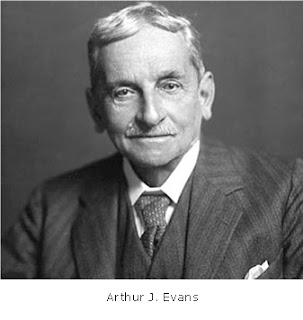
Today, The Grandma has been reading about Arthur J. Evans, the British archeologist who began excavating Knossos Palace, the center of Cretan civilization, on a day like today in 1900.

Knossos, in Ancient Greek Κνωσός, is the largest Bronze Age archaeological site on Crete and has been called Europe's oldest city.

Settled as early as the Neolithic period, the name Knossos survives from ancient Greek references to the major city of Crete.

The name Knossos was formerly Latinized as Cnossus or Cnossos and occasionally Knossus, Gnossus, or Gnossos but is now almost always written Knossos.

The palace of Knossos eventually became the ceremonial and political centre of the Minoan civilization and culture.

The palace was abandoned at some unknown time at the end of the Late Bronze Age, c. 1380-1100 BC; the reason is unknown, but one of the many disasters that befell the palace is generally put forward.

In the First Palace Period, around 2000 BC, the urban area reached a size of as many as 18,000 people. In its peak, the palace and surrounding city boasted a population of 100,000 people shortly after 1700 BC.

The site of Knossos has had a very long history of human habitation beginning with the founding of the first Neolithic settlement (c. 7000 BCE). Neolithic remains are prolific in Crete. They are found in caves, rock shelters, houses, and settlements. Knossos has a thick Neolithic layer indicating the site was a sequence of settlements before the Palace Period. The earliest was placed on bedrock.

Arthur J. Evans, who unearthed the palace of Knossos in modern times, estimated that c. 8000 BCE a Neolithic people arrived at the hill, probably from overseas by boat, and placed the first of a succession of wattle and daub villages, modern radiocarbon dates have raised the estimate to c. 7000–6500 BCE.

Large numbers of clay and stone incised spools and whorls attest to local cloth-making. There are fine ground axe and mace heads of colored stone: greenstone, serpentine, diorite and jadeite, as well as obsidian knives and arrowheads along with the cores from which they were flaked. Most significant among the other small items were a large number of animal and human figurines, including nude sitting or standing females. Evans attributed them to the worship of the Neolithic mother goddess and figurines in general to religion.

More information: Archaeopress

Sir Arthur John Evans (8 July 1851-11 July 1941) was a British archaeologist and pioneer in the study of Aegean civilization in the Bronze Age.

He is most famous for unearthing the palace of Knossos on the Greek island of Crete. Based on the structures and artefacts found there and throughout the eastern Mediterranean, Evans found that he needed to distinguish the Minoan civilisation from Mycenaean Greece.

Evans was also the first to define Cretan scripts Linear A and Linear B, as well as an earlier pictographic writing.

Arthur Evans was born in Nash Mills, Hemel Hempstead, Hertfordshire, England, the first child of John Evans (1823-1908) and Harriet Ann Dickinson (born 1824), the daughter of John's employer, John Dickinson (1782–1869), the inventor and founder of Messrs John Dickinson, a paper mill.

John Evans came from a family of men who were both educated and intellectually active but undistinguished by either wealth or aristocratic connection. His father, Arthur Benoni Evans, Arthur's grandfather, had been headmaster of Dixie Grammar School at Market Bosworth, Leicestershire. John knew Latin and could quote the classical authors.

More information: Crete Classics


 Modern schools and universities push students
into habits of depersonalized learning,
alienation from nature and sexuality,
obedience to hierarchy, fear of authority,
self-objectification, and chilling competitiveness.
These character traits are the essence
of the twisted personality-type of modern industrialism.
They are precisely the character traits needed
to maintain a social system that is utterly out
of touch with nature, sexuality and real human needs.

Arthur Evans

Friday, 18 March 2022

PHOEBE, THE AMAZING IRREGULAR SATELLITE OF SATURN

Today, The Grandma has received the wonderful visit of one of her closest friends, Joseph de Ca'th Lon.

Joseph loves Astronomy, and they have been talking about Phoebe, the satellite of Saturn that became first to be discovered with photographs, taken in August 1898, by William Henry Pickering on a day like today in 1899.

Phoebe is an irregular satellite of Saturn with a mean diameter of 213 km.

It was discovered by William Henry Pickering on March 18, 1899 from photographic plates that had been taken starting on 16 August 1898 at the Boyden Station of the Carmen Alto Observatory near Arequipa, Peru, by DeLisle Stewart. It was the first satellite to be discovered photographically.

Phoebe was the first target encountered upon the arrival of the Cassini spacecraft in the Saturn system in 2004, and is thus unusually well-studied for an irregular satellite of its size. Cassini's trajectory to Saturn and time of arrival were specifically chosen to permit this flyby. After the encounter and its insertion into orbit, Cassini did not go much beyond the orbit of Iapetus.

Phoebe is roughly spherical and has a differentiated interior. It was spherical and hot early in its history and was battered out of roundness by repeated impacts. It is believed to be a captured centaur that originated in the Kuiper belt.

Phoebe is the second largest retrograde satellite in the solar system after Triton.

Phoebe was discovered by William Henry Pickering on 17 March 1899 from photographic plates that had been taken starting on 16 August 1898 at the Boyden Observatory near Arequipa, Peru, by DeLisle Stewart. It was the first satellite to be discovered photographically.

More information: NASA

Phoebe was named after Phoebe, a Titaness in Greek mythology that was associated with the Moon. It is also designated Saturn IX in some scientific literature.

The IAU nomenclature standards have stated that features on Phoebe are to be named after characters in the Greek myth of Jason and the Argonauts.

In 2005, the IAU officially named 24 craters (Acastus, Admetus, Amphion, Butes, Calais, Canthus, Clytius, Erginus, Euphemus, Eurydamas, Eurytion, Eurytus, Hylas, Idmon, Iphitus, Jason, Mopsus, Nauplius, Oileus, Peleus, Phlias, Talaus, Telamon and Zetes).

Phoebe's orbit is retrograde; that is, it orbits Saturn opposite to Saturn's rotation. For more than 100 years, Phoebe was Saturn's outermost known moon, until the discovery of several smaller moons in 2000.

Phoebe is almost 4 times more distant from Saturn than its nearest major neighbor (Iapetus), and is substantially larger than any of the other moons orbiting planets at comparable distances.

All of Saturn's regular moons except Iapetus orbit very nearly in the plane of Saturn's equator. The outer irregular satellites follow moderately to highly eccentric orbits, and none are expected to rotate synchronously as all the inner moons of Saturn do, except for Hyperion.

The Phoebe ring is one of the rings of Saturn. This ring is tilted 27 degrees from Saturn's equatorial plane, and the other rings. It extends from at least 128 to 207 times the radius of Saturn; Phoebe orbits the planet at an average distance of 215 Saturn radii.

The ring is about 40 times as thick as the diameter of the planet. Because the ring's particles are presumed to have originated from micrometeoroid impacts on Phoebe, they should share its retrograde orbit, which is opposite to the orbital motion of the next inner moon, Iapetus. Inwardly migrating ring material would thus strike Iapetus's leading hemisphere, contributing to its two-tone coloration. Although very large, the ring is virtually invisible -it was discovered using NASA's infrared Spitzer Space Telescope.

Material displaced from Phoebe's surface by microscopic meteor impacts may be responsible for the dark areas on the surface of Hyperion. Debris from the biggest impacts may be the origin of the other moons of Phoebe's group (the Norse group) -all of which are less than 10 km in diameter.

Phoebe is roughly spherical and has a diameter of 213±1.4 km, approximately one-sixteenth that of the Moon.

Phoebe rotates every nine hours 16 minutes and it completes a full orbit around Saturn in about 18 months. Its surface temperature is on average -198.2 °C.

Most of Saturn's inner moons have very bright surfaces, but Phoebe's albedo is very low (0.06), as dark as lampblack. The Phoebean surface is heavily scarred, with craters up to 80 kilometres across, one of which has walls 16 kilometres high.

Phoebe's dark coloring initially led to scientists surmising that it was a captured asteroid, as it resembled the common class of dark carbonaceous asteroids.

These are chemically very primitive and are thought to be composed of original solids that condensed out of the solar nebula with little modification since then.

However, images from Cassini indicate that Phoebe's craters show a considerable variation in brightness, which indicate the presence of large quantities of ice below a relatively thin blanket of dark surface deposits some 300 to 500 metres thick. In addition, quantities of carbon dioxide have been detected on the surface, a finding that has never been replicated for an asteroid.

It is estimated that Phoebe is about 50% rock, as opposed to the 35% or so that typifies Saturn's inner moons. For these reasons, scientists are coming to think that Phoebe is in fact a captured centaur, one of a number of icy planetoids from the Kuiper belt that orbit the Sun between Jupiter and Neptune.

Phoebe is the first such object to be imaged as anything other than a dot.

Despite its small size, Phoebe is thought to have been a spherical body early in its history, with a differentiated interior, before solidifying and being battered into its current, slightly non-equilibrium shape.

More information: Science on a Sphere

Apart from one regio named after Phoebe's daughter, Leto, all named features are craters named after characters from the Greek legend of Jason and the Argonauts.

Phoebe formed in the Kuiper belt within three million years after the origin of the Solar System. This was early enough that sufficient radioactive material was available to melt it into a sphere and stay warm enough to have liquid water for tens of millions of years.

Unlike Saturn's other moons, Phoebe was not favorably placed for the Voyager probes. Voyager 2 observed Phoebe for a few hours in September 1981. In the images, taken from a distance of 2.2 million kilometres at low phase angle, the size of Phoebe was approximately 11 pixels and showed bright spots on the otherwise dark surface.

Cassini passed 2,068 kilometres from Phoebe on 11 June 2004, returning many high-resolution images, which revealed a scarred surface. Because Voyager 2 had not been able to produce any high quality images of Phoebe, obtaining them was a priority for the Cassini mission and its flight path was deliberately designed to take it close by; otherwise, Cassini would likely not have returned images much better than Voyager's.

Because of Phoebe's short rotation period of approximately 9 hours, 17 minutes, Cassini was able to map virtually the entire surface of Phoebe. The close fly-by enabled the mass of Phoebe to be determined with an uncertainty of only 1 in 500.

More information: The European Space Agency

Voyager found Saturn to be a planet with a complex interior,
atmosphere, and magnetosphere.
In its rings -a vast, gleaming disk of icy rubble-
the mission recorded signs of the same physical mechanisms
that were key in configuring the early solar system
and similar disks of material around other stars.

Carolyn Porco

Thursday, 17 March 2022

THE FIRST RAILWAY LINE IS OPENED IN FINLAND IN 1862

Today, The Grandma has been reading about trains. She loves them and she has searched information about Päärata, the first railway line of Finland between cities of Helsinki and Hämeenlinna that was officially opened on a day like today in 1862.

The Finnish Main Line, in Finnish Päärata and in Swedish Stambanan, is a 810-kilometre long electrified main railway line in Finland, today between the cities of Helsinki and Oulu.

The Main Line was first time opened on March 17, 1862; at that time, the 108-kilometre railway line only stretched between Helsinki and Hämeenlinna.

The railway passes Helsinki, Riihimäki, Hämeenlinna, Tampere, Parkano, Seinäjoki, Kokkola, Ylivieska and Oulu. The future Suomirata project aims to improve the current Riihimäki-Tampere section either by building additional tracks on the existing main line or an entirely new straight line. The goal is to reduce the travel time from Tampere to Helsinki from the current 1 hour 33 minutes to about an hour.

The Finnish railway network consists of a total track length of 9,216 km of railways built with broad 1,524 mm commonly known as Russian gauge track, of which 3,249 km of track is electrified.

Passenger trains are operated by the state-owned enterprise VR that runs services on 7,225 km of track. These services cover all major cities and many rural areas, though the coverage is less than the coverage provided by the bus services.

Most passenger train services originate or terminate at Helsinki Central railway station, and a large proportion of the passenger rail network radiates out of Helsinki. VR also operates freight services. Maintenance and construction of the railway network itself is the responsibility of the Finnish Rail Administration, which is a part of the Finnish Transport Agency, in Finnish Väylävirasto, in Swedish Trafikledsverket.

The network consists of six areal centres, that manage the use and maintenance of the routes in co-operation. Cargo yards and large stations may have their own signalling systems.

Finnish trains have a reputation for being spacious, comfortable and clean. The scenery surrounding the railway lines is considered to be of outstanding natural beauty, especially in Eastern Finland with its many lakes. Because in most parts of Finland the density of population is low, Finland is not very well suited for railways.

More information: VR

Commuter services are nowadays rare outside the Helsinki area, but there are express train connections between most of the cities. As in France, passenger services are mostly connections from various parts of the country to the capital, Helsinki.

Nightly passenger trains only operate on the busiest lines between Helsinki or Turku via Oulu to Lapland. This leaves most of the tracks free for nightly freight traffic (c.40 M tons/y. In addition there are also good long-distance bus and airplane connections, both of which are generally little or a lot more expensive than trains. Buses are sometimes faster and/or cheaper than trains.

The first rail line between Helsinki and Hämeenlinna (today part of the Finnish Main Line) was opened on January 31, 1862.

As Finland was then the Grand Duchy of Finland, a region of Imperial Russia, railways were built to the broad Russian track gauge of 1,524 mm. An extension from Riihimäki to the new Finland Station in Saint Petersburg was opened in 1870. However, the Finnish and Russian rail systems remained unconnected until 1912. Russian trains could not have used the Finnish rail network due to a narrower load gauge. Later the Finnish load gauge was widened to match the Russian load gauge, with hundreds of station platforms or tracks moved further apart from each other.

Further expansion occurred in the 1800s and by 1900 much of the network had been constructed with 3,300 km of track built.

The Finland Railway Bridge across the River Neva in Saint Petersburg, opened in 1912, connected the Finnish State Railways to Russian Railways. Following Finnish independence, the Russian part of the line was handed over to Russian authorities.

Most passenger rail services in Finland radiate from Helsinki Central, serving most major cities including Tampere, Turku, Oulu, Rovaniemi, Kouvola, Kuopio, Jyväskylä and Joensuu among others. Some towns are connected to the rail network by their own branch lines, yet are not served by passenger trains; examples include Porvoo, Uusikaupunki, Raahe and Rauma.

More information: Finland Trains


Railway termini are our gates
to the glorious and the unknown.
Through them we pass out into adventure and sunshine,
to them, alas! we return.

E. M. Forster

Wednesday, 16 March 2022

RACHEL CORRIE, THE AMERICAN ACTIVIST KILLED BY IDF

Today, The Grandma has been reading about Rachel Corrie, the American activist who was killed by an Israel Defense Forces bulldozer while trying to obstruct the demolition of a home in Rafah on a day like today in 2003.

Rachel Aliene Corrie (April 10, 1979-March 16, 2003) was an American activist and diarist.

A member of the pro-Palestinian group International Solidarity Movement (ISM), she was crushed to death by an Israel Defense Forces (IDF) armored bulldozer in a southern Gaza Strip combat zone during the height of the second Palestinian intifada under contested circumstances.

She had gone to Gaza as part of her college senior-year independent-study proposal to connect her home town and Rafah as sister cities. While there, she had joined other ISM activists in efforts to prevent the Israeli army's demolition of Palestinian houses.

According to the Israeli authorities the demolitions were carried out to eliminate weapons-smuggling tunnels. According to human rights groups the demolitions were used as collective punishment.

The exact nature of her death and the culpability of the bulldozer operator are disputed, with fellow ISM protestors saying that the Israeli soldier operating the bulldozer deliberately ran over Corrie, and Israeli eyewitnesses saying that it was an accident since the bulldozer operator could not see her.

The Israeli army conducted an investigation, which concluded that the death was an accident, and that the driver of the bulldozer could not see Corrie due to limited visibility from his cab. Amnesty International and Human Rights Watch as well as B'Tselem and Yesh Din criticized the military investigation.

More information: The Guardian

Corrie was born on April 10, 1979, and raised in Olympia, Washington. She was the youngest of three children of Craig Corrie, an insurance executive, and Cindy Corrie. Cindy describes their family as average Americans -politically liberal, economically conservative, middle class.

After graduating from Capital High School, Corrie went on to attend The Evergreen State College, also in Olympia, where she took a number of arts courses. She took a year off from her studies to work as a volunteer in the Washington State Conservation Corps. According to the ISM, she spent three years making weekly visits to mental patients.

While at Evergreen State College she became a committed peace activist arranging peace events through a local pro-ISM group called Olympians for Peace and Solidarity. She later joined the International Solidarity Movement (ISM) organisation in order to protest the policies of the Israeli army in the West Bank and Gaza Strip.

In her senior year, she proposed an independent-study program in which she would travel to Gaza, join the ISM team, and initiate a 'sister city' project between Olympia and Rafah. Before leaving, she also organized a pen-pal program between children in Olympia and Rafah.

While in Rafah, Corrie stood in front of armored bulldozers, in an alleged attempt to impede house demolitions which were being carried out. Demolitions were a common tactic employed along the security road near the border between Israel and Egypt at Rafah to uncover explosive devices and destroy tunnels used by terrorists to smuggle weapons from Egypt to Gaza.

More information: AA

These military operations were criticized as collective punishment by some human rights groups. Israel authorities said that demolitions were necessary because Palestinian gunmen used the structures as cover to shoot at their troops patrolling in the area, or to conceal arms-smuggling tunnels under the Gaza-Egypt border.

Corrie was a member of a group of about eight activists from outside of the Palestinian territories who tried to prevent the Israeli army's activities by acting as human shields.

On March 16, 2003, the IDF was engaged in an operation involving the demolition of Palestinian houses in Rafah.

Corrie was part of a group of three British and four American ISM activists attempting to disrupt the IDF operation. Corrie placed herself in the path of a Caterpillar D9R armored bulldozer in the area and was run over by the bulldozer and fatally injured.

After she was injured she was taken by a Red Crescent ambulance to the Palestinian Najar hospital, arriving at the emergency room at 5:05 pm, still alive but in critical condition. At 5:20 pm she was declared dead.

More information: The Guardian


I think freedom for Palestine could be
an incredible source of hope to people
struggling all over the world.
I think it could also be an incredible inspiration
to Arab people in the Middle East,
who are struggling under undemocratic regimes
which the U.S. supports.

Rachel Corrie

Tuesday, 15 March 2022

WOMEN'S BOAT RACE, CAMBRIDGE VS OXFORD COURSE

Today, The Grandma has been reading about the Women's Boat Race, annual rowing race between Cambridge University Women's Boat Club and Oxford University Women's Boat Club that was first rowed on a day like today in 1927.

The Women's Boat Race is an annual rowing race between Cambridge University Women's Boat Club and Oxford University Women's Boat Club.

First rowed in 1927, the race has taken place annually since 1964. Since the 2015 race it has been rowed on the same day and course as the men's Boat Race on the River Thames in London, taking place around Easter, and since 2018 the name The Boat Race has been applied to the combined event. The race is rowed in eights and the cox can be of any gender.

The course covers a 6.8 km stretch of the Thames in West London, from Putney to Mortlake. Members of both crews are traditionally known as blues and each boat as a Blue Boat, with Cambridge in light blue and Oxford dark blue.

As of 2021 Cambridge have won the race 45 times and Oxford 30 times. Cambridge has led Oxford in cumulative wins since 1966. The women's race has received television coverage and grown in popularity since 2015, attracting a television audience of 4.8 million viewers that year. The 2019 race was won by Cambridge by five lengths.

The first women's rowing event between Oxford and Cambridge was held on 15 March 1927 on The Isis in Oxford. This was not solely a race in the years up to 1935, the two boats were not on the river together and were judged on both their speed and their steadiness, finish, rhythm and other matters of style.

More information: The Boat Race

The Times reported that large and hostile crowds gathered on the towpath and The New York Times stated a crowd of fully five thousand persons was on hand as a willing cheering section. The race covered a distance of approximately 0.80 km over which the crews were judged on their style while rowing downstream and their speed while rowing back upstream.

Reports differ as to the judges' opinions on style: one suggests they failed to agree on a winner, another indicates that they deemed the style of each crew to be equal. As a result, the judges based their decision on speed: the race was won by Oxford in a time of 3 minutes 36 seconds, beating Cambridge by 15 seconds.

The next event in 1929 took place on the Tideway in London. At the 1935 race, after two intervening events, the crews took to the river together for the first time. Racing on the Thames in London Oxford's boat was sent off first with the Cambridge boat following thirty seconds later.

The 1936 race, held on The Isis, was the first to take place side by side. Later, the location alternated between the River Cam in Cambridge and The Isis, over a distance of about 1,000 yards. Unlike the men's race, the women's continued in most years through the Second World War.

More information: Cambridge University Boat Club

The Cambridge University Women's Boat Club was founded in 1941 when Girton College became the second women's college to cater for rowing

Until that year Cambridge was represented by Newnham College Boat Club. The first blues were awarded in 1941 when CUWBC raced against Oxford University Women's Boat Club, which had been founded in 1926.

All of the Cambridge rowers in 1941 were members of Newnham College. The following year the first non-Newnham rower competed.

In training after the 1952 race, Oxford rowed over a weir and was banned from the river. Both OUWBC and later CUWBC suffered from lack of funds and the race fell into abeyance. After a 12-year gap, the race restarted in 1964 and has been held annually since.

The number of women rowers increased as more colleges started to admit women and reserve boats from each university began racing in 1966, the year after the men's reserve boats began racing.

A second reserve race was run in 1968, and the reserves have raced annually since 1975. The women's reserve boats were later named Osiris (Oxford) and Blondie (Cambridge).

The race has been won 45 times by Cambridge and 30 times by Oxford, with Cambridge leading Oxford in cumulative wins since 1966. The reserves race has been won 28 times by Cambridge and 20 times by Oxford, with Cambridge leading in cumulative wins since the inception of the race.

More information: Oxford University Boat Club


No one will do for you
what you need to do for yourself.
We cannot afford to be separate.
We have to see that all of us are in the same boat.

Dorothy Height

Monday, 14 March 2022

WILLIAM MCCHORD HURT, CHILDREN OF A LESSER GOD

Today, The Grandma has been reading sad news about William Hurt, the American actor who died yesterday at 71 in Portland, Oregon.

William McChord Hurt (March 20, 1950-March 13, 2022) was an American actor. He studied at the Juilliard School and began acting on stage in the 1970s.

Hurt's film debut was a troubled scientist in Ken Russell's science-fiction feature Altered States, released in 1980, for which he received a Golden Globe nomination for New Star of the Year.

In 1981 he played a leading role, as a lawyer who succumbs to the temptations of a married woman played by Kathleen Turner, in the neo-noir Body Heat.

Hurt garnered three consecutive nominations for the Academy Award for Best Actor, for Kiss of the Spider Woman (1985), Children of a Lesser God (1986), and Broadcast News (1987), winning for the first of these.

Hurt remained an active stage actor throughout the 1980s, appearing in Off-Broadway productions including Henry V, Fifth of July, Richard II and A Midsummer Night's Dream.

Hurt received his first Tony Award nomination in 1985 for the Broadway production of Hurlyburly.

After playing character roles in the following decade, Hurt earned his fourth Academy Award nomination for his supporting performance in David Cronenberg's crime thriller A History of Violence (2005). His later career films roles include turns in A.I. Artificial Intelligence (2001), The Village (2004), Syriana (2005), The Good Shepherd (2006), Mr. Brooks (2007), Into the Wild (2007), Robin Hood (2010), and the Marvel Cinematic Universe films, in which he portrayed Thaddeus Ross.

More information: Rogert Ebert

Hurt was born March 20, 1950, in Washington, D.C., the son of Claire Isabel, who worked for Time Inc., and Alfred McChord Hurt, who worked for the United States Agency for International Development and State Department.

He had two brothers. With his father, he lived in Lahore, Mogadishu and Khartoum. His parents divorced and, in 1960, his mother married Henry Luce III (1925-2005), a son of publisher Henry Luce.

Hurt attended the Middlesex School, where he was vice-president of the Dramatics Club and had the lead role in several school plays. He graduated in 1968 and his yearbook predicted, you might even see him on Broadway.

Hurt attended Tufts University and studied theology, but turned instead to acting and joined the Juilliard School (Drama Division Group 1972–1976).

Hurt began his career in stage productions, only later acting in films. From 1977 to 1989, he was a member of the acting company at Circle Repertory Company. He won an Obie Award for his debut appearance there in Corinne Jacker's My Life, and won a 1978 Theatre World Award for his performances in Fifth of July, Ulysses in Traction, and Lulu.

In 1979, Hurt played Hamlet under the direction of Marshall W. Mason opposite Lindsay Crouse and Beatrice Straight. His first major film role was in the science-fiction film Altered States where his performance as an obsessed scientist gained him wide recognition.

His performance with Richard Crenna, Ted Danson and newcomer Kathleen Turner in Lawrence Kasdan's neo-noir classic Body Heat elevated Hurt to stardom, and he later also co-starred in Kasdan's The Big Chill (1983).

Hurt would star opposite Turner again in Kasdan's film The Accidental Tourist (1988). He appeared in the thriller Gorky Park opposite Lee Marvin. He received the Best Male Performance Prize at the Cannes Film Festival and the Academy Award for Best Actor for Kiss of the Spider Woman in 1985.

He received three additional Oscar nominations: Best Actor for Children of a Lesser God (1986) and Broadcast News (1987; he was thus nominated for Best Actor for three consecutive years) and Best Supporting Actor for A History Of Violence (2005). Hurt also starred in Tuck Everlasting as Angus Tuck.

Often cast as an intellectual, Hurt starred in films such as Lost in Space, but was also effective in other kinds of roles, as in I Love You to Death and David Cronenberg's psychological drama A History of Violence (2005), where in less than 10 minutes of screen time he plays the creepy mob boss, Richie Cusack. Also in 2005, Hurt played a mysterious government operative in Stephen Gaghan's ensemble drama about the politics of big oil, Syriana.

Hurt was in the miniseries adaptation of Stephen King's Nightmares and Dreamscapes, in a piece entitled Battleground, also notable for its complete lack of dialogue. He plays Renshaw, a hitman who receives a package from the widow of a toymaker he had killed, unaware of what is waiting inside for him. He appeared in the cast of Vanya, an adaptation of Chekhov's Uncle Vanya, at the Artists Repertory Theatre in Portland, Oregon.

In June 2007, Marvel Studios announced that Hurt would portray General Thaddeus Ross in the 2008 film The Incredible Hulk alongside Edward Norton, Liv Tyler and Tim Roth.

Hurt reprised his role in Captain America: Civil War (2016), Avengers: Infinity War (2018), Avengers: Endgame (2019), and Black Widow (2021).

 More information: The Washington Post

He appeared in Sean Penn's film Into the Wild, the true story of Christopher McCandless. He appeared as President Henry Ashton in the 2008 action-thriller Vantage Point. Hurt also played Mr. Brooks's alter ego in Mr. Brooks, which starred Kevin Costner.

In 2009, Hurt became a series regular on the FX series Damages playing a corporate whistleblower opposite Glenn Close and Marcia Gay Harden. For his role in the series, he earned a 2009 Primetime Emmy Award nomination in the Outstanding Supporting Actor in a Drama Series category.

Hurt's 2009 Sundance film The Yellow Handkerchief was released in theaters on February 26, 2010, by Samuel Goldwyn Films. He was in the Thailand-based 2011 thriller Hellgate alongside Cary Elwes and Paula Taylor, directed by John Penney.

In September 2010, Hurt played United States Secretary of the Treasury Henry Paulson in the HBO film Too Big to Fail, an adaptation of Andrew Ross Sorkin's book. He also starred as Captain Ahab in the 2011 television adaptation of Herman Melville's novel Moby-Dick.

In 2018, Hurt was cast as the lead in The Coldest Game (2019), but after he was injured in an off-set accident, he was replaced by Bill Pullman.

Hurt had been set to appear in the series Pantheon and films The Fence, Men of Granite, and Edward Enderby before his death in March 2022. It is unknown if he ever finished or filmed these roles.

He died at his home in Portland, Oregon on March 13, 2022, one week before his 72nd birthday.

More information: BBC


 I'm an actor.
I play roles in films and theaters.
I don't act out, and I don't play people.

William Hurt

Sunday, 13 March 2022

DANA DELANY, GREAT TV ROLES & STRONG ACTIVISM

Today, The Grandma has been watching some TV series like China Beach and Desperate Housewives, both of them interpreted by Dana Delany, the American actress and activist who was born on a day like today in 1956.

Dana Welles Delany (born March 13, 1956) is an American actress.

After appearing in small roles early in her career, Delany received her breakthrough role as Colleen McMurphy on the ABC television drama China Beach (1988-1991), for which she twice received the Primetime Emmy Award for Outstanding Lead Actress in a Drama Series in 1989 and 1992.

She received further recognition for her appearances in the films Light Sleeper (1992), Tombstone (1993), Exit to Eden (1994), The Margaret Sanger Story (1995), Fly Away Home (1996), True Women (1997), and Wide Awake (1998).

Delany is also a known voice actress, having voiced characters in the DC Animated Universe, notably as Andrea Beaumont in Batman: Mask of the Phantasm and Lois Lane in Superman: The Animated Series, Justice League and Justice League Unlimited, subsequently reprising the latter role in several projects unrelated to the DCAU.

In the 2000s, Delany appeared in main roles on several short-lived television series, including Pasadena (2001), Presidio Med (2002-2003), and Kidnapped (2006-2007).

From 2007 to 2010, she starred as Katherine Mayfair on the ABC television series Desperate Housewives, for which she received a Prism Award in 2009. Delany then starred as Megan Hunt on the ABC medical drama Body of Proof (2011-2013), and as Crystal Harris on the Amazon drama series Hand of God (2014-2017).

More information: Twitter-Dana Delany

Delany was born in New York City, the daughter of Mary and Jack Delany. She has a sister, Corey, and a brother, Sean. She is of Irish and English descent and was raised Roman Catholic. She has stated that, even as a little girl, she always wanted to go into acting.

The reason a person first gets into acting is because you want attention from your parents as a little girl, she told a reporter. In her childhood, she went with her family to many Broadway shows and was fascinated by films.

Delany was a member of the Hollywood Women's Political Committee. Since the mid-1990s, Delany has served on the board of the Scleroderma Research Foundation, and with her friend Sharon Monsky, she helped campaign for support in finding a cure for scleroderma.

Delany is a board member of the arts advocacy organization Creative Coalition. In addition, she has supported Planned Parenthood.

More information: Dana Delany Fan Website


Television is more of a business.
You can't take as many risks,
because there's so many channels now,
and the advertising's dropping.

Dana Delany