Tuesday, 1 November 2016

AMAZING GRACE! I ONCE WAS LOST, BUT NOW AM FOUND

Amazing Grace
is a Christian hymn published in 1779, with words written by the English poet and Anglican clergyman John Newton (1725–1807).

Newton wrote the words from personal experience. He grew up without any particular religious conviction, but his life's path was formed by a variety of twists and coincidences that were often put into motion by his recalcitrant insubordination.
 
He was pressed, conscripted, into service in the Royal Navy, and after leaving the service, he became involved in the Atlantic slave trade. 

In 1748, a violent storm battered his vessel off the coast of County Donegal, Ireland, so severely that he called out to God for mercy, a moment that marked his spiritual conversion. He continued his slave trading career until 1754 or 1755, when he ended his seafaring altogether and began studying Christian theology.

Ordained in the Church of England in 1764, Newton became curate of Olney, Buckinghamshire, where he began to write hymns with poet William Cowper. 

Amazing Grace was written to illustrate a sermon on New Year's Day of 1773. It is unknown if there was any music accompanying the verses; it may have simply been chanted by the congregation. It debuted in print in 1779 in Newton and Cowper's Olney Hymns but settled into relative obscurity in England. In the United States, however, Amazing Grace was used extensively during the Second Great Awakening in the early 19th century. It has been associated with more than 20 melodies, but in 1835 it was joined to a tune named New Britain to which it is most frequently sung today.

With the message that forgiveness and redemption are possible regardless of sins committed and that the soul can be delivered from despair through the mercy of God, Amazing Grace is one of the most recognizable songs in the English-speaking world. Author Gilbert Chase writes that it is without a doubt the most famous of all the folk hymns, and Jonathan Aitken, a Newton biographer, estimates that it is performed about 10 million times annually. 

It has had particular influence in folk music, and has become an emblematic African American spiritual. Its universal message has been a significant factor in its crossover into secular music. Amazing Grace saw a resurgence in popularity in the U.S. during the 1960s and has been recorded thousands of times during and since the 20th century, occasionally appearing on popular music charts.

More information: The John Newton Project


 Amazing grace! how sweet the sound,
That saved a wretch; like me!
I once was lost, but now am found,
Was blind, but now I see.
 
John Newton

Monday, 31 October 2016

FROM OCCITANIA TO THE USA: HONOUR TO THE DEAD

The Grandma's celebrates Castanyada
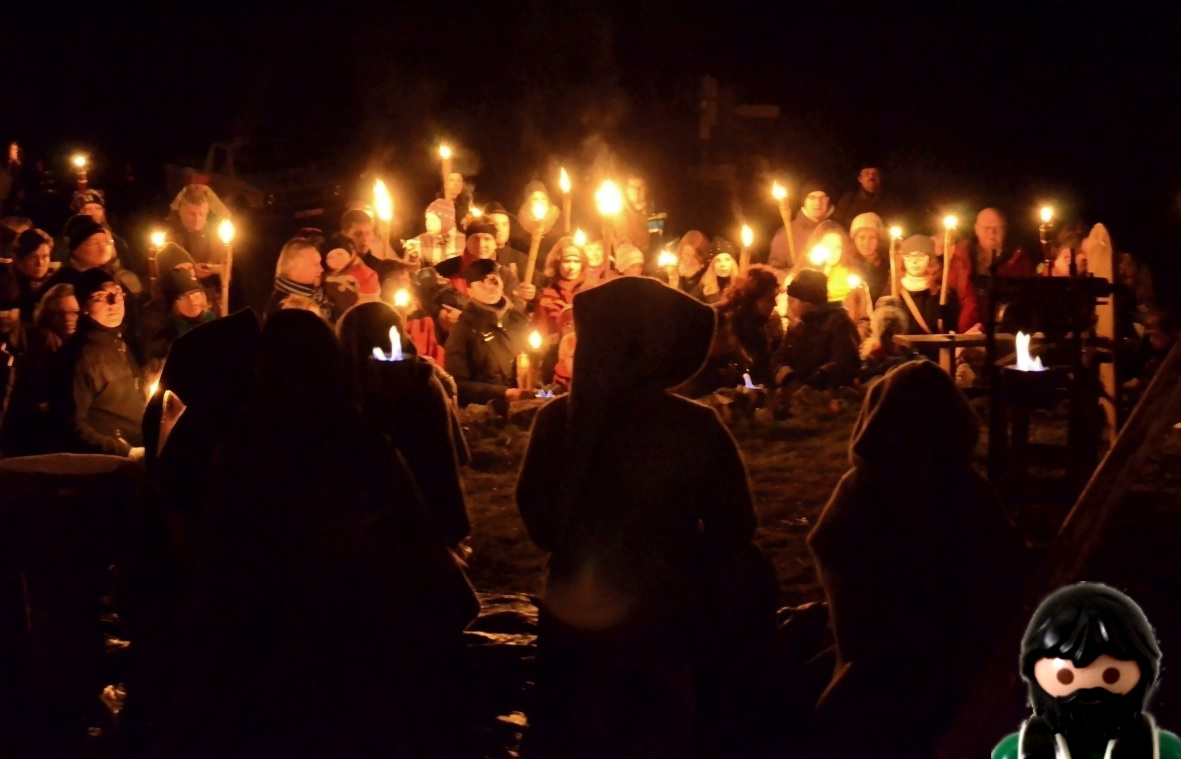
Castanyada, Magosto or Magüestu, Samhaín and Halloween are popular festivals mainly on All Saints' Day. In Catalonia, Andorra and Occitania, celebrations involve eating roast chestnuts, panellets or baked sweet potato and preserved fruit, candied or glazed fruit, typically with moscatell to drink. 

It seems that the tradition of eating these foods comes from the fact that during All Saints' night, on the eve of All Souls' Day in the Christian tradition, bell ringers would ring bells in commemoration of the dead into the early morning. Friends and relatives would help with this task, and everyone would eat these foods for sustenance.

Other versions of the story state that the Castanyada originates at the end of the 18th century and comes from the old funeral meals, where other foods, such as vegetables and dried fruit were not served. The meal had the symbolic significance of a communion with the souls of the departed: while the chestnuts were roasting, prayers would be said for the person who had just died.

The festival is usually depicted with the figure of a castanyera: an old lady, dressed in peasant's clothing and wearing a headscarf, sitting behind a table, roasting chestnuts for street sale.


Tina Picotes celebrates Magosto/Magüestu
The Magosto or Magüestu is the essential Galician, Asturian and Portuguese autumn pagan festival. In addition to chestnuts and local young wine, various foods have been incorporated such as sausages and other products made from the pig slaughter, which occurs precisely at that time. 

Chestnut festival is traditionally celebrated in the same grove, starting early in the afternoon to collect firewood and chestnuts. One or more bonfires are lit with sticks and pine needles. Young people took to the streets. It was customary for the girls to bring the chestnuts, and for the boys to bring the wine. Chestnuts are roasted on the floor, directly in the fire. Children play to dirt their faces with soot and ash. The adults dance and sing, jumping over the remains of the fire.


Samhain is a Gaelic festival marking the end of the harvest season and the beginning of winter, or the "darker half" of the year. Traditionally, it is celebrated from the very beginning of one Celtic day to its end, or in the modern calendar, from sunset on 31 October to sunset on 1 November, this places it about halfway between the autumn equinox and the winter solstice. It is one of the four Gaelic seasonal festivals, along with Imbolc, Beltane and Lughnasadh. 

Joseph de Ca'th Lon celebrates Samhaín
Historically, it was widely observed throughout Ireland, Scotland and the Isle of Man. Similar festivals are held at the same time of year in other Celtic lands; for example the Brythonic Calan Gaeaf in Wales, Kalan Gwav in Cornwall, and Kalan Goañv in Brittany.

Samhain is believed to have Celtic pagan origins, and there is evidence it has been an important date since ancient times. The Mound of the Hostages, a Neolithic passage tomb at the Hill of Tara, is aligned with the Samhain sunrise. It is mentioned in some of the earliest Irish literature, and many important events in Irish mythology happen or begin on Samhain.

More information: Samhaín (Celtic Guide)

Halloween or Hallowe'en, a contraction of All Hallows' Evening, also known as Allhalloween, All Hallows' Eve, or All Saints' Eve, is a celebration observed in a number of countries on 31 October, the eve of the Western Christian feast of All Hallows' Day. It begins the three-day observance of Allhallowtide,  the time in the liturgical year dedicated to remembering the dead, including saints, hallows, martyrs, and all the faithful departed.

Claire Fontaine celebrates Halloween
Halloween's activities include trick-or-treating, attending Halloween costume parties, carving pumpkins into jack-o'-lanterns, lighting bonfires, apple bobbing, divination games, playing pranks, visiting haunted attractions, telling scary stories and watching horror films. 

In many parts of the world, the Christian religious observances of All Hallows' Eve, including attending church services and lighting candles on the graves of the dead, remain popular, although elsewhere it is a more commercial and secular celebration. Some Christians historically abstained from meat on All Hallows' Eve, a tradition reflected in the eating of certain foods on this vigil day, including apples, potato pancakes and soul cakes.

It was not until mass Irish and Scottish immigration in the 19th century that Halloween became a major holiday in North America. Confined to the immigrant communities during the mid-19th century, it was gradually assimilated into mainstream society and by the first decade of the 20th century it was being celebrated coast-to-coast by people of all social, racial and religious backgrounds.

More information: History of Trick-or-Treating


The fear of death follows from the fear of life.
A man who lives fully is prepared to die at any time

Mark Twain

Sunday, 30 October 2016

ORSON WELLES & H.G.WELLS' THE WAR OF THE WORLDS

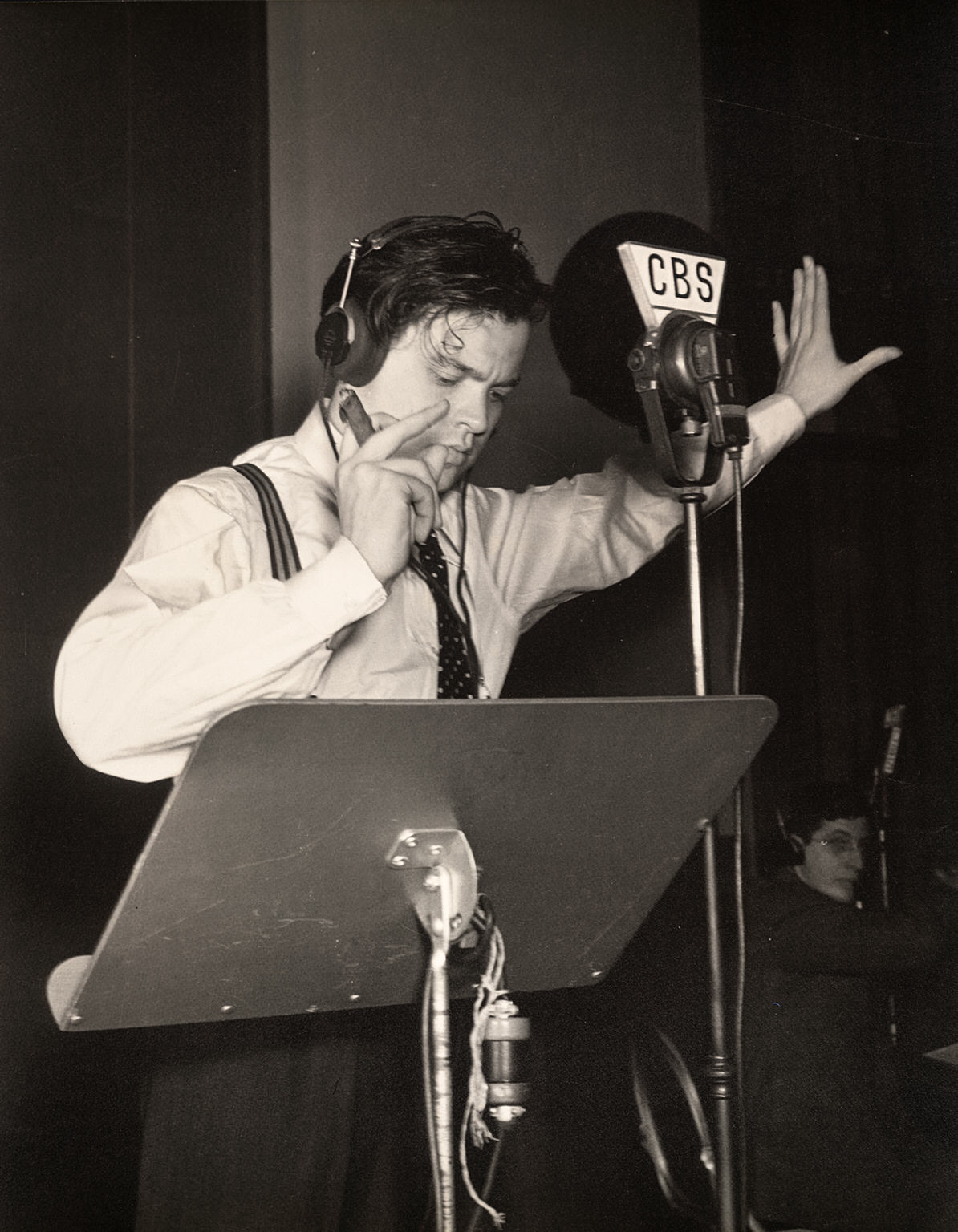
Orson Welles in the radio
We know now that in the early years of the 20th century, this world was being watched closely by intelligences greater than man's and yet as mortal as his own. We know now that as human beings busied themselves about their various concerns, they were scrutinized and studied, perhaps almost as narrowly as a man with a microscope might scrutinize the transient creatures that swarm and multiply in a drop of water. 

With infinite complacence, people went to and fro over the earth about their little affairs, serene in the assurance of their dominion over this small spinning fragment of solar driftwood which by chance or design man has inherited out of the dark mystery of Time and Space. Yet across an immense ethereal gulf, minds that are to our minds as ours are to the beasts in the jungle, intellects vast, cool and unsympathetic, regarded this earth with envious eyes and slowly and surely drew their plans against us.

In the 39th year of the 20th century came the great disillusionment. It was near the end of October. Business was better. The war scare was over. More men were back at work. Sales were picking up. On this particular evening, October 30th, the Crossley service estimated that 32 million people were listening in on radios…
More information: The Smithsonian Magazine

The War of the Worlds is an episode of the American radio drama anthology series The Mercury Theatre on the Air. It was performed as a Halloween episode of the series on Sunday, October 30, 1938, and aired over the Columbia Broadcasting System radio network. Directed and narrated by actor and future filmmaker Orson Welles, the episode was an adaptation of H.G.Wells' novel The War of the Worlds (1898). It became famous for allegedly causing mass panic, although the reality of the panic is disputed as the program had relatively few listeners.

Orson Welles & The Daily News
The first two-thirds of the one-hour broadcast was presented as a series of simulated news bulletins, which suggested an actual alien invasion by Martians was currently in progress. The illusion of realism was furthered because The Mercury Theatre on the Air was a sustaining show without commercial interruptions, and the first break in the program came almost 30 minutes into the broadcast. Popular legend holds that some of the radio audience may have been listening to Edgar Bergen and tuned in to The War of the Worlds during a musical interlude, thereby missing the clear introduction that the show was a drama, but recent research suggests this only happened in rare instances.

In the days following the adaptation, widespread outrage was expressed in the media. The program's news-bulletin format was described as deceptive by some newspapers and public figures, leading to an outcry against the perpetrators of the broadcast and calls for regulation by the Federal Communications Commission. The episode secured Welles's fame as a dramatist.

More information: The War of the Worlds (Script)


Create your own visual style... 
let it be unique for yourself and yet identifiable for others.
 
Orson Welles

Friday, 28 October 2016

SOME STORIES ABOUT CAPITAL VICES: GREED (III)

Ration Card during the Post-War
November, 1950

She was a girl. She didn’t understand why her parents were so important for the neighbourhood. His father was a milkman; her mother took care of the little greengrocers shop.
 
She had learnt how to survive in the middle of a Post-War. It was a terrible age because the population lived under a great poverty and it was very difficult to get food and daily products. Her parents helped as people as they could. The neighbourhood had to share aliments and basic needs. Solidarity appears in the worst moments when the most important is not living but surviving.

She grew up and was a hard worker teenager who looked after her brothers and helped in the little shop. It was normal in that age. She was the girl of the family. The Post-War continued. Nobody hoped a fast final. Life was grey and lots of new neighbours arrived to the suburb. They came from Andalusia, Castile, Galicia, Valence, Murcia, Balearic Islands or Aragon. They were poor people who had lost few things that they had and had decided to start a new life in the Catalan capital.

More neighbours, same things to share. The dictatorship had established a new card to restrict the access to elementary aliments. Solidarity again and a great effort of every member of that community made possible the subsistence with the enormous collaboration of her parents. The little shop was the neuralgic centre of the suburb because it had a great objective: feed the neighbourhood despite of the dictatorship controls.

November, 2016
The Grandma in front of Roser's home

Today, she’s in front of the shop, where she has been living since she was born, 73 years ago. Times have changed. She’s looking at her home with pain. Lots of neighbours have wanted to stay with her in this difficult moment. She locks the door for the last time and takes her beloved things. She says goodbye to her home, her suburb and many years of shared experiences. A new project of the City Hall wants to destroy her home to build new houses. Wow! It's necessary to expel old neighbours to welcome new ones. It's a project of the City Hall. It's not a private project.

When The Antichrist arrived to the City Hall promised to help all people without distinction in their search of basic things: home and work. Some people, like The Grandma, didn’t believe her and they received lots of nagging and bad words. One year and half later, the city is a great chaos. All elementary things have increased their prices in more than 10%; social services don’t run with efficacy and there’s a great feeling of having been abandoned by the City Hall.

This is Roser’s story, today. This can be your story, tomorrow.

Ladies and gentlemen, enjoy The Antichrist and her new policy!

Thursday, 27 October 2016

LURDES HOLMES IN THE CATHEDRAL OF SEA: ACTION!

Lurdes Holmes in Santa Maria del Mar, Barcelona
Today, The Holmes have received news from Lurdes. 

She's working in a new project in Barcelona. She's a main character in a historic film, a beautiful story about the citizens of Barcelona during the XIV century and how they built one of the most incredible buildings of the city.

The Grandma, who is still in Belgrade, has received the news with emotion and happiness. She's very proud of Lurdes and very happy for her. In her youth, The Grandma worked as a tourist guide and she remembers clearly how people enjoyed when they discovered the secrets of the cathedral of sea: Santa Maria del Mar.


It's a great honour for The Grandma sharing this information of one of the most important free guides nowadays, our Wiki:

Santa Maria del Mar (Saint Mary of the Sea) is an imposing church in the Ribera district of Barcelona, built between 1329 and 1383 at the height of Catalonia's maritime and mercantile preeminence. It is an outstanding example of Catalan Gothic, with a purity and unity of style that is very unusual in large medieval buildings.

Santa Maria del Mar, Barcelona
The first mention of a church of Santa Maria by the sea dates from 998. The construction of the present building was promoted by the canon Bernat Llull, who was appointed Archdean of Santa Maria in 1324. Construction work started on 25 March 1329, when the foundation stone was laid by king Alfons III of Catalonia, as commemorated by a tablet in Latin and Catalan on the façade that faces the Fossar de les Moreres.

The architects in charge were Berenguer de Montagut, designer of the building, and Ramon Despuig, and during the construction all the guilds of the Ribera quarter were involved. The walls, the side chapels and the façades were finished by 1350. In 1379 there was a fire that damaged important parts of the works. 

Finally, on 3 November 1383 the last stone was laid and on 15 August 1384 the church was consecrated. In 1428 an earthquake caused several casualties and destroyed the rose window in the west end. The new window, in the Flamboyant style, was finished by 1459  and one year later the glass was added. The images and the Baroque altar were destroyed in a fire in 1936. The chapel of the Blessed Sacrament, adjacent to the apse, was added in the 19th century.

More information: Santa Maria del Mar

From the outside, Santa Maria gives an impression of massive severity that belies the interior. It is hemmed in by the narrow streets of the Ribera, making it difficult to obtain an overall impression, except from the Fossar de les Moreres and the Plaça de Santa Maria, both of them former burial grounds. The latter is dominated by the west end of the church with its rose window. Images of Saint Peter and Saint Paul occupy niches on either side of the west door, and the tympanum shows the Saviour flanked by Our Lady and Saint John.

Details of iron workers on the main door
The north-west tower was completed in 1496, but its companion was not finished until 1902.

In contrast with the exterior, the interior gives an impression of light and spaciousness. It is of the basilica type, with its three aisles forming a single space with no transepts and no architectural boundary between nave and presbytery. The simple ribbed vault is supported on slender octagonal columns, and abundant daylight streams in through the tall clerestorey windows.


The interior is almost devoid of imagery of the sort to be found in Barcelona's other large Gothic churches, the cathedral and Santa Maria del Pi, after the fire which occurred in 1936 during anticlerical disturbances. Amongst the most notable of the works destroyed at that time was the Baroque retable by Deodat Casanoves and Salvador Gurri.

According to the art historian Josep Bracons, the basic unit of measurement used in Santa Maria del Mar was the mediaeval foot of 33 centimetres. Measured in this way, the side chapels are 10 feet deep, the width of the side aisles is double this, while the central aisle is four times as wide, that is, 40 feet. The total width of the church is thus 100 mediaeval feet, which is also equal to the maximum height of the building.


I don't know if it will be the best temple in the world. 
I assure you that it will be unique. 

The Cathedral of Sea

Tuesday, 25 October 2016

PABLO PICASSO: THE UNIVERSAL GENIUS OF CUBISM

Pablo Picasso
The Grandma is in Belgrade. She arrived on The Orient Express and she's going to stay until tomorrow. Belgrade was the capital of Yugoslavia, a republic built with the union of different old nations. It's impossible to forget the Balkan Wars at the end of the last century. Thousands and thousands of people died as a consequence of them and The Grandma remembers the city of Srebrenica in Bosnia clearly and dramatically.

Today is the anniversary of Pablo Picasso. Picasso painted one of the most beautiful pictures, Gernika. Gernika is a Basque town which was bombed by the Italian and German aviation during the Spanish Civil War.

Gernika remembers Srebrenica as clearly as remembers Aleppo or Mossul nowadays. The question is how much time we need to take conscience about war only creates destruction, pain and horrible consecuences to the future generations.  

Pablo Picasso (25 October 1881 – 8 April 1973) was a Spanish painter, sculptor, printmaker, ceramicist, stage designer, poet and playwright who spent most of his adult life in France. Regarded as one of the greatest and most influential artists of the 20th century, he is known for co-founding the Cubist movement, the invention of constructed sculpture, the co-invention of collage, and for the wide variety of styles that he helped develop and explore. Among his most famous works are the proto-Cubist Les Demoiselles d'Avignon (1907), and Gernika (1937).

More information: Picasso Museum Barcelona

Exceptionally prolific throughout the course of his long life, Picasso achieved universal renown and immense fortune for his revolutionary artistic accomplishments, and became one of the best-known figures in 20th-century art. 

The bombing of Gernika, 26 April 1937, was an aerial bombing of the Basque town of Guernica during the Spanish Civil War. It was carried out at the behest of the Spanish nationalist government by its allies, the Nazi German Luftwaffe's Condor Legion and the Fascist Italian Aviazione Legionaria, under the code name Operation Rügen.

More information: Gernika-Lumo Town Council

The attack gained infamy because it involved the deliberate targeting of civilians by a military air force. The number of victims is still disputed; the Basque government reported 1,654 people killed at the time, while Spanish figures claim around 126. An English source used by the Air War College claims 400 civilians died. Russian archives reveal 800 deaths on 1 May 1937, but this number may not include victims who later died of their injuries in hospitals or whose bodies were discovered buried in the rubble.


 Everything you can imagine is real - Pablo Picasso

Monday, 24 October 2016

DIGITAL REPUTATION: THE LIMITS IN INTERNET

We live in the age of the Social Networks. It's a fact. We have all the information that we want only with a click but this could be very dangerous if we don't protect ourselves of this permanent exposition.

Today, Claire Fontaine wants to talk us about digital reputation and shares an interesting report published in cyberbullying.com. It's not only a question of protectinc ourselves, it's also the responsability of protecting our children.
 
Let's go to read the report...

We live in a society where online searches tend to influence – if not drive – many of our decisions. If we are looking for a good doctor in the area, a potential vacation spot, or advice on what electronics to purchase this holiday season, we will perform searches using our phone, tablet, or computer. It is so easy and has become almost second-nature. That said, we don’t just look up inanimate objects and places – we look up individuals all the time.

More information: Digital Reputation

Most of the time, our information searches tend not to be that in-depth unless what turns up attracts and motivates us to search for more. We spend a few minutes using a few keywords online, and if we like what we see, we may probe deeper. However, if we don’t like what we see within a very short span of time, we will be done with it, and move on. Applying this to information searches about people, it is critical that what is found about you (or me, or anyone) via a simple search engine query induces the person searching to want to learn more. If what is found is questionable, or problematic, or shady, or just plain odd – it stands out very starkly and leads to the formation of a strong and sometimes bad impression. That negative opinion or feeling, then, usually ends the potential for any type of connection.

The first step in controlling your reputation is finding out exactly what is out there and what employers and college administrators are finding when they search for you. You can begin by running your first and last name through Google, Facebook, Bing, Twitter, and other sites where searches are possible. This will mirror the first step that potential employers and admissions coordinators usually take. Next, remove any inappropriate images or communications from your social media profiles or blogs to reduce any negative impressions others may have.


It takes 20 years to build a reputation and five minutes to ruin it. If you think about that, you'll do things differently.
 
Warren Buffett